Episode Summary
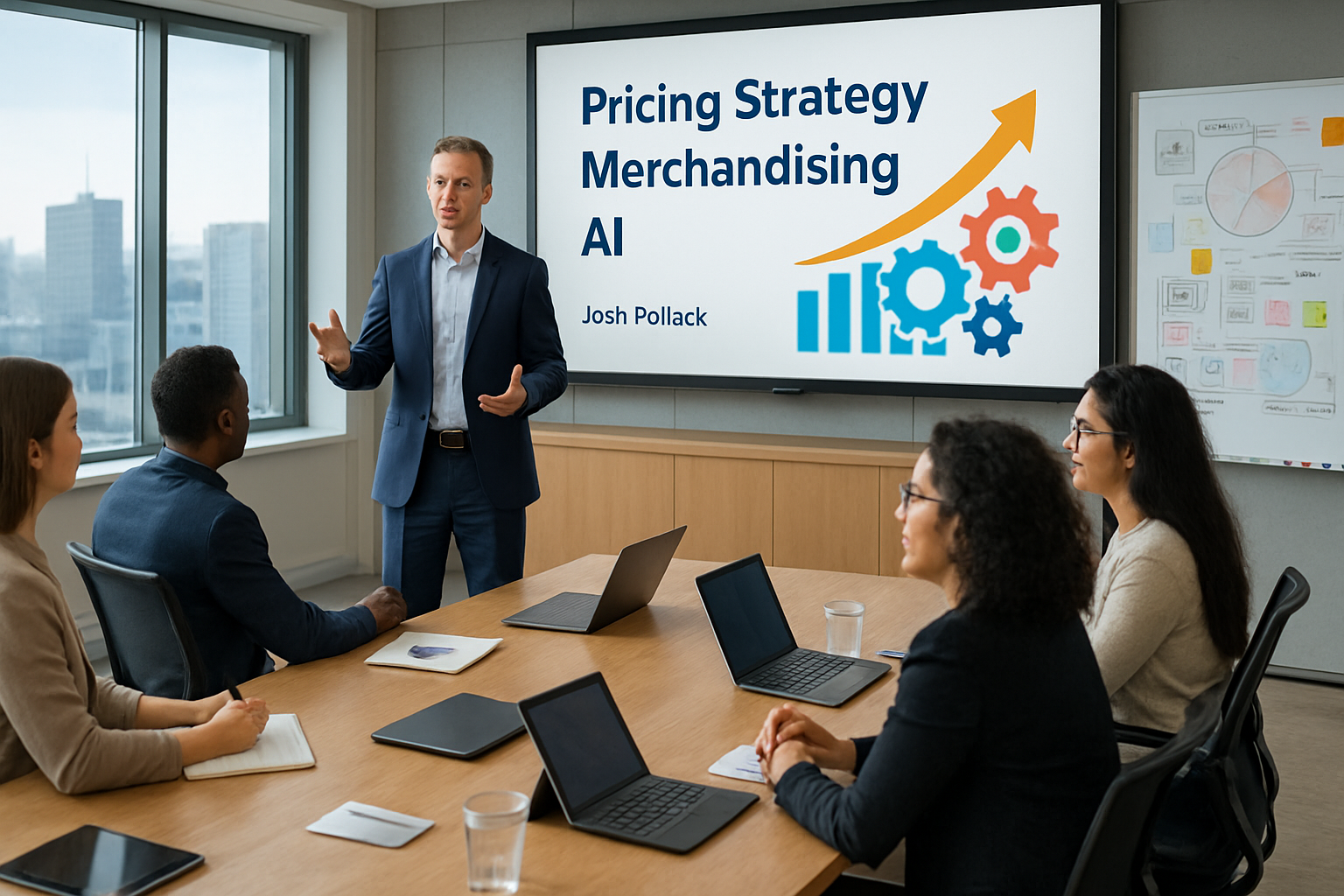
In this episode of Pricing Heroes, we chat with Josh Pollack, President and Principal Consultant at Pollack Retail Solutions. With over 25 years of experience in retail strategy, Josh has led pricing, forecasting, and inventory management at major retailers like Sam’s Club and Circuit City. He has also spearheaded pricing transformations at ALDI (both US and International), PetSmart, FullBeauty Brands, and Cabela’s. Throughout his career, Josh has operated at the intersection of pricing, merchandising, technology, and analytics, striving to align these disciplines in ways that optimize profit while maintaining customer trust.
From Theater to Retail: A Roundabout Journey into Pricing
Josh’s entry into the retail world was anything but conventional. He started out pursuing theater and even earned a degree in the discipline, only to discover later that his interest in the creative process could merge effectively with the analytical rigor of business. “I didn’t start out thinking, ‘I’m going to be a retail executive and then a pricing expert,’” he admits, illustrating how sometimes the best career paths emerge unexpectedly. Yet his theater background taught him something vital in business: the sanctity of deadlines. “When a show opens on Friday night, it opens—whether you’re ready or not,” he says. This mindset served him well in merchandising, where creativity and data must coalesce to shape the customer experience. Over time, after earning an MBA, he grew increasingly focused on pricing as a powerful lever that can shape both profitability and brand perception.
His combination of artistic flair and data-driven discipline eventually propelled him to lead major pricing transformations, demonstrating that unconventional beginnings can lead to exceptional contributions. By approaching merchandising and pricing with a sense of urgency and structure, Josh was able to navigate complexities that others might have found daunting, developing holistic solutions that ultimately improved both financial outcomes and customer experiences.
Why Merchandising and Pricing Need Each Other
Having led both merchandising and pricing teams, Josh recognizes that conflict often arises when pricing reports to a separate analytics or finance function, rather than being tightly integrated with merchandising. “You want to manage product design and product lines around a pricing structure that meets profit targets, inventory targets, and creates real value for customers,” he explains, highlighting how tightly interwoven product and price decisions can be in industries such as apparel and footwear. He believes that in less commoditized categories, merchants need the freedom to align pricing with the broader brand vision, rather than treating it as a standalone, numbers-only exercise.
Even so, Josh cautions that simply handing pricing authority to the merchant team is not enough: genuine collaboration requires clearly defined roles, shared performance goals, and a transparent flow of information. In his view, the most successful retailers ensure that pricing teams deliver robust analytical insights while remaining respectful of the merchant’s product expertise. By structuring incentives to reward both analytical rigor and creative thinking, companies can create a unified approach to product and price—a synergy that ultimately enhances brand health and drives better margins without alienating customers.
Thriving in Volatile Markets: Balancing Profit and Perception
Josh predicted in his blog post, Taming the Price Volatility in 2023 and Beyond, that inflation, supply chain disruptions, and geopolitical uncertainty would keep markets volatile, forcing retailers to navigate tricky pricing waters. “If you continuously raise prices on lower-elasticity items, you risk noticeable deterioration in value perception,” he warns, emphasizing that short-term margin gains can quickly erode brand loyalty if consumers feel taken advantage of. He cites retailers like Costco and ALDI, which focus on consistent, fair pricing to foster lasting goodwill, as prime examples of how balanced strategies can yield substantial customer loyalty.
Still, Josh acknowledges that a singular low-price model is not feasible for every business. Many retailers adopt a hybrid approach, with high-visibility, price-sensitive items kept competitively low while other products see carefully calibrated increases. He notes that this strategy can indeed boost profits, provided brands remain vigilant about customer sentiment. By monitoring overall basket size, frequency of visits, and long-term changes in brand perception, retailers can gauge whether their pricing shifts are sustainable. Maintaining open communication about rising costs or strategic changes also helps preempt the feeling among consumers that they are being exploited.
AI, Dynamic Pricing, and the Risk of Eroding Brand Equity
As AI-driven price optimization becomes more widespread, retailers gain the ability to update prices rapidly in response to changes in demand, competitor moves, or inventory levels. “We’re in a grand experiment,” Josh says, describing how shoppers might perceive dynamic, real-time price adjustments as unfair—particularly if they see different prices than their neighbors for the same items. This sentiment could intensify in brick-and-mortar environments with Electronic Shelf Labels (ESLs), where shelf prices may fluctuate minute by minute. While loyalty-based discounts and personalized promotions can be easier for consumers to accept, even these strategies require care to avoid appearing arbitrary or manipulative.
Josh stresses that brands should treat AI-powered pricing as a complement to human judgment, rather than a replacement. He advocates for small-scale pilots—where a handful of products are subject to dynamic rules—before rolling out broad changes. In his view, retailers must establish clear guardrails to preserve fairness and transparency. He argues that data-driven insights are invaluable, but they should be folded into a larger strategy that recognizes emotional factors driving shopper behavior. By proceeding thoughtfully and acknowledging the psychological dimensions of price, retailers can harness AI to grow margins without undermining the trust they have worked hard to build.
Beyond Shrinkflation: Maintaining Integrity and Quality
For brands under pressure to protect margins, shrinkflation and skimpflation have become tempting tactics: slightly reducing product quantity or quality while keeping prices the same. However, Josh remains skeptical of the long-term benefits, noting that “the whole idea is to hide the fact that you’re giving the customer less,” which can come back to haunt businesses once consumers catch on. Although such tactics might provide a near-term boost to profitability, they can damage a brand’s reputation and breed distrust among loyal customers.
He suggests that retailers consider openly communicating necessary price hikes to avoid eroding product integrity. By preserving quality and being forthright about cost drivers—be they higher input costs or supply chain challenges—companies can maintain a stronger bond with their audience. Where shrinkflation tends to rely on customer ignorance, transparency fosters respect and a perception of fairness, which can often sustain brand loyalty even in times of economic turbulence.
The Road Ahead: AI Improvements Versus Macroeconomic Shifts
While AI undoubtedly offers incremental gains in pricing accuracy and forecasting, Josh sees broader macroeconomic factors—tariffs, shifting trade policies, and geopolitical upheaval—as even more consequential forces. “You might move from a 75% accurate forecast to 85%, which is good,” he explains, “but that shift is modest compared to, say, a tariff change that disrupts entire sourcing strategies.” For retailers, this means that while advanced analytics and automation provide essential daily support, the capacity to pivot quickly in response to external shocks remains critical.
Maintaining agility in the face of large-scale disruptions requires a blend of data-driven tools and strategic foresight. In Josh’s view, companies that couple sophisticated technology with leadership willing to adapt major facets of their supply chain or product assortment will be best positioned to ride out unpredictable markets. AI is an increasingly powerful ally, but real resilience also relies on proactive, high-level decision-making that anticipates how external changes ripple through pricing and profitability.
Recommended Resources
For pricing professionals looking to expand their horizons, Josh suggests:
- The Indicator, a podcast by Planet Money
- Artificial Intelligence: A Guide for Thinking Humans by Melanie Mitchell
Transcript
Aaron: Hello and welcome to Pricing Heroes, a podcast sponsored by Competera. This is a series of interviews with the best-in-class retail pricing experts driving bottom-line metrics for major retail brands and the industry as a whole. Today's guest is Josh Pollack. Josh is the President and Principal Consultant at Pollack Retail Solutions, where he helps retailers enhance their pricing, forecasting, and inventory management strategies using AI and advanced analytics. With 25+ years of experience in retail strategy, he led merchandise planning and inventory management at Sam's Club (where he oversaw the pricing function) and oversaw pricing at Circuit City. As a consultant, Josh has led major pricing transformations for retailers including ALDI (both US and International), PetSmart, FullBeauty Brands, and Cabela's. Throughout his career, he has worked at the intersection of pricing, merchandising, technology, and analytics, helping retailers optimize profitability and competitive positioning. Josh, welcome to the show!
Josh: Thank you very much for having me. I’m thrilled to be here, and thank you for those kind introductory words.
Aaron: Would you like to begin by telling us a little bit about yourself and how you found your way into retail merchandising and pricing?
Josh: Sure. It was a bit of a roundabout path. I didn’t start out in life thinking, “Okay, I’m going to be a retail executive and then a pricing expert.” I actually started out with a passion for the arts. I was very involved in theater as a young person, growing up as a theater kid. I was involved in acting and in theater production throughout high school and actually have an undergraduate degree in the discipline. After getting out of school, I spent a couple of years pursuing that direction professionally, but unfortunately my artistic aspirations came up against my middle-class aspirations. I started to realize that theater might not be the best choice to attain the material comfort I was interested in. So, I moved into the business world as a way of making money. I started doing marketing in the construction industry, of all places, and ended up as the Director of Marketing for an architecture firm in Manhattan. But once I realized the business direction was where I wanted to go, I went back to school and got an MBA. Then I decided to go into retail because it felt like an industry where I could combine my interest in the creative process with my interest in business—particularly the merchandising function, where there is some creative input. And of course, as a merchant, pricing is one of the key “controllables” you have to manage the business. So pricing was always top of mind for me, but there weren’t a lot of analytic tools back then to help support pricing decisions; it was largely based on looking at product performance at different price points—just sort of eyeballing it. Over time, because of my training in analytics and data from my MBA, I started to gravitate more into inventory management functionality, which is heavily dependent on forecasting. I developed expertise in forecasting, then began to see that same approach applied to pricing as new software tools came onto the market—like ProfitLogic—that had a big impact on retail. Pricing, in particular, was appealing to me because among all the levers you can pull as a merchant, it has the highest impact on both the customer experience and the bottom line.
Aaron: I’m surprised to hear you have a background in theater. Did you find that the skills you developed as a theater student provided you a competitive advantage once you entered the business world?
Josh: It did, but surprisingly, not necessarily in the areas most people assume. Most people think, “Oh, so you’re good in front of people; your verbal skills are good.” And while that may be true—though it comes and goes—what the theater world really taught me was responsibility. When a show opens after all those weeks and months of preparation, you set that date, and on Friday night, the show will open, whether you’re ready or not. It taught me to respect deadlines and treat them as sacrosanct. It took me years of business experience to sort of unlearn that to some extent, because business deadlines can sometimes be more flexible, but it was really ingrained in me from theater.
Aaron: That’s a great answer—I like that. Do you have a favorite play? Maybe one that you performed in?
Josh: I was lucky enough to be cast in one of the great roles in one of the great plays: Mark Antony in Julius Caesar. For anyone who isn’t aware, “Friends, Romans, countrymen, lend me your ears...” is one of the most famous speeches in the English language. It’s remarkable to stand in front of an audience and channel that poetry through your body. It’s an incredibly electric experience. The people I was working with were consummate actors who’ve gone on to have pretty exciting careers. It was an incredible, formative experience.
Aaron: Thanks for sharing. So do you prefer Elizabethan or Jacobean theater specifically, or are your tastes more broad?
Josh: My tastes are more broad. I was typecast as more of a classical actor due to my “type” in school, but I started to feel more comfortable and at home working on contemporary projects—where I could draw on my own experiences and my own tendencies.
Aaron: Thanks for sharing. Now, you’ve worked in pricing and merchandising. We know these two teams often have competing priorities, yet their decisions directly impact each other. Having spent so much time working across both functions, what are the biggest challenges in how these teams collaborate? And what steps can pricing professionals take to work more effectively with their merchandising peers?
Josh: Yeah, it’s a terrific question. I have seen merchants and pricing teams working at cross purposes. If you have a situation with misaligned incentives, you’ll end up with conflict. The obvious answer is that if you want the pricing team to be in harmony with the merchandising team, you need to align their incentives. You also need to ensure there are clear roles, responsibilities, and boundaries. Now, I’m someone who believes that the merchant should have control over pricing in the same way they have control over the product, distribution, etc., to fulfill their larger objectives. So I tend to believe the pricing team (and any analytics or data inputs) should advise the merchant, but the merchant needs to be able to make decisions—even if those decisions diverge from analytics—because certain factors can’t always be captured by the most sophisticated model.
Aaron: That’s interesting because I don’t often hear that perspective from people who advise on pricing structures. I’d love a more robust defense of that position, if you wouldn’t mind providing one.
Josh: Sure. It could be related to the categories where I’ve spent most of my time—apparel, footwear, consumer electronics, general merchandise, and grocery. But my deeper background is in apparel and footwear, which is less commoditized, so you have a lot more “wiggle room” on merchandising decisions. Pricing is part of that. If you’re in a heavily commoditized environment, I understand that maybe the dynamics are different. As for reporting structures, I’ve seen pricing teams report to inventory management, finance, or merchandising. The intent can be creating checks and balances and injecting analytical rigor, but that can also lead to competing incentives. If they do have different reporting structures, I think it’s critical that incentives are laid out so the pricing team is encouraged to provide the best possible advice to the merchandising team, rather than being at odds with them. In environments where the pricing team has taken over pricing responsibility, I’ve sometimes seen poor outcomes, because there’s insufficient integration with decisions on product offerings, cost, and distribution, which are all intimately tied to merchandising. Those decisions are best taken together. You want to manage product design and product lines around a pricing structure that meets profit targets, inventory targets, and creates real value for customers.
Aaron: I appreciate that perspective. I’m hearing more about teams shifting to a hybrid model—where pricing is deeply embedded with merchandising, sales, and marketing, yet also has a seat at the table in the C-suite or reports directly to the CEO. It’s helpful to hear a contrasting viewpoint, where in certain industries pricing might primarily reside with the merchant.
Josh: Yes, it does depend on how much “top-down” control an organization wants. If senior executives want to sign off on every individual price change—even something as small as a five-cent increase—then it can slow down speed and flexibility. I think it also depends on whether you’re in a business model with highly dynamic pricing, or “surge pricing,” where the changes happen so quickly you can’t really run each individual change through an approval process. That environment might favor a different structure for the pricing team. But yeah, I’m probably showing my bias: I came up through the merchant ranks, and in the old-school worldview, the “four Ps” [product, price, place, promotion] all belong to the merchant.
Aaron: Fair enough. Let’s pivot to a different topic. In your blog post Taming the Price Volatility in 2023 and Beyond, you described how economic uncertainty, supply chain disruptions, and inflation have forced retailers to rethink pricing strategies. Given our current political and economic climates, what have been the smartest pricing actions you’ve seen retailers take in response to this volatility—or that you might recommend? And do you think 2025 will resemble past periods of uncertainty, such as 2023 or even the late 2010s?
Josh: That’s a terrific question. It’s always interesting to talk about an essay that was written at a slightly different moment in time. That said, I don’t think we’re going to see a reduction in market volatility. Back then, we were largely dealing with the impact of COVID on the supply chain and the war in Ukraine. Since then, we’ve had continuing supply chain issues, and I don’t expect that to let up soon. I see retailers under intense pressure to drive profit margins, which goes hand in hand with maximizing shareholder value. Pricing decisions are basically about distributing profit between shareholders and customers, and right now it seems that more of that value is going to shareholders. In terms of retailers doing this well, I actually see an opportunity in doing the opposite: adopting what I’d call a fair pricing or low-price approach—like Costco or ALDI—and reaping the rewards of positive customer sentiment and loyalty. Meanwhile, the more typical move these days is to drive up price margins. In the long run, I see that as potentially eroding brand equity. If a retailer can’t or won’t adopt truly fair, low pricing across the board, then a classic tactic is to look at price elasticity across different products, focusing on high-visibility, price-sensitive items—keeping them competitively priced—while raising prices on products where the customer is less sensitive. That strategy can work if executed carefully, but you do risk pushback if you do it repeatedly or too aggressively.
Aaron: That definitely aligns with data we’ve seen. Often, decreases on certain products can actually lead to higher total basket sizes and increased revenue. Over time, though, you might exhaust those easy wins. Is there a danger of eventually doing more harm than good?
Josh: Absolutely. If you continuously raise prices on lower-elasticity items, you risk noticeable deterioration in value perception. Over the long term, that can harm your brand. Consumers may also start to feel manipulated or exploited if, for instance, they discover someone else is paying less for the same thing. We see that a lot in the airline industry, which is famous for price discrimination—and famously disliked for it. In retail, at least for now, consumers have more choices. They can still vote with their wallets and go to a retailer who isn’t as aggressive with price discrimination. So the big question is whether we’ll see a tipping point where dynamic or personalized pricing becomes so widespread that consumers just have to accept it, as they did with airlines.
Aaron: Building on that, you’ve highlighted the tension between AI-driven price optimization and consumer demand for transparency. Is there a way for retailers to strike a balance between maximizing margin with these advanced tools and earning customer trust? Maybe something akin to John Rawls’ notion of justice, where localized or even personalized pricing might be acceptable if it’s seen as fair. Have you seen a retailer that does this well?
Josh: The best examples I’ve seen are actually in promotions, where the customer can more easily rationalize differences in discounts. For instance, if one shopper gets a special promotion via an app or a loyalty program, another shopper doesn’t automatically feel “robbed.” They can mentally attribute it to different buying behavior or membership status. That sort of dynamic discounting is more palatable. For regular, everyday shelf prices, however, if a retailer shows me one price and someone else a completely different price right beside me in the aisle, I’d find that deeply unfair. Online is a different story—you might be getting a personalized price without even knowing it. But in-store, with an electronic shelf label (ESL), the consumer can feel unsettled if they suspect the price might change as soon as they turn around. I think we’re still in a grand experiment. Customers might resist or protest these tools. On the other hand, if enough retailers adopt them in lockstep, it becomes harder for consumers to avoid. We saw that in airlines, too, where Southwest initially benefited from simpler, more “fair” pricing but eventually moved to a more nuanced approach to remain competitive.
Aaron: That’s interesting. With ESLs in particular, do you have thoughts on how retailers might maintain consumer confidence while using this technology?
Josh: I don’t have a definitive answer; I think we’ll see some retailers try various approaches. We’re in uncharted territory. One possibility is that as dynamic pricing becomes more common, a retailer that promises consistency and transparency might gain an advantage—much like Trader Joe’s has done with simple, hand-written signs. If enough consumers value that stability, it could be a differentiator.
Aaron: Agreed. Maybe a retailer can actually highlight their price stability to prove its fairness. Let’s pivot slightly. You’ve discussed other trends like “shrinkflation” and “skimpflation,” where brands reduce quantity or quality while keeping prices the same. In the long term, this erodes brand equity. Is there a way for pricing teams to enhance perceived value without eroding trust—or do these stealthy measures inherently contradict transparency?
Josh: Unfortunately, those practices are inherently not transparent. Their whole purpose is that the customer won’t notice. Over time, customers do notice, and they start to feel the product is shoddy or the package is mostly air. I’m personally a believer in honesty with customers. If a company keeps adulterating its product to meet margin targets, it’s a sign of a deeper corporate values problem.
Aaron: Moving back to broader pricing trends: looking ahead, what do you see as the major factors shaping retail pricing over the next few years? Will AI ultimately make pricing more consumer-friendly, or more complex and opaque?
Josh: AI and automation will definitely be major factors. But I think macroeconomic elements, like tariffs and supply chain disruption, will overshadow technology in the near term. If we reevaluate tariffs, for instance, that changes sourcing and cost structures across entire categories. As for AI, the fundamental idea of price optimization—based on forecasting and elasticity—has been around for decades. AI offers improvements, but it’s not a total revolution. You might jump from a 75% accurate forecast to 85%, which is good, but not earth-shattering. So, in the immediate future, I believe macro factors will drive much bigger pricing shifts.
Aaron: Great insights. Final question: what books, podcasts, or other resources would you recommend to our community of pricing professionals?
Josh: One podcast I really enjoy is The Indicator by Planet Money. It’s short and focuses on a specific metric or measure each day, then explores the broader economic implications. As for books, there’s one on AI that I liked a lot, especially for those new to the topic: Artificial Intelligence: A Guide for Thinking Humans by Melanie Mitchell. She starts with pattern recognition, like optical character recognition, and uses that to illustrate how AI “thinks.” It gave me a much better sense of what these technologies can and can’t do.
Aaron: Excellent. I’ll be sure to link those in the show notes. Josh, thank you for being on the show and sharing your insights with us today.
Josh: It was a pleasure, and you asked great, in-depth questions. Thanks so much, Aaron—I really appreciate it.
Aaron: I hope you enjoyed our conversation with Josh Pollock. Be sure to follow and connect with our guest on LinkedIn. For more information about AI pricing solutions, visit Competera.ai. Remember to subscribe to the show on your favorite podcast app so you don’t miss future episodes, and please help us reach others in the pricing community by leaving a five-star review. If you find the insights in this show valuable, I encourage you to check out the Retail Pricing Community on LinkedIn, where you’ll find pricing professionals sharing their expertise and latest trends. Thanks for joining us on this episode of Pricing Heroes. Take care—until next time.

.png)