Episode Summary
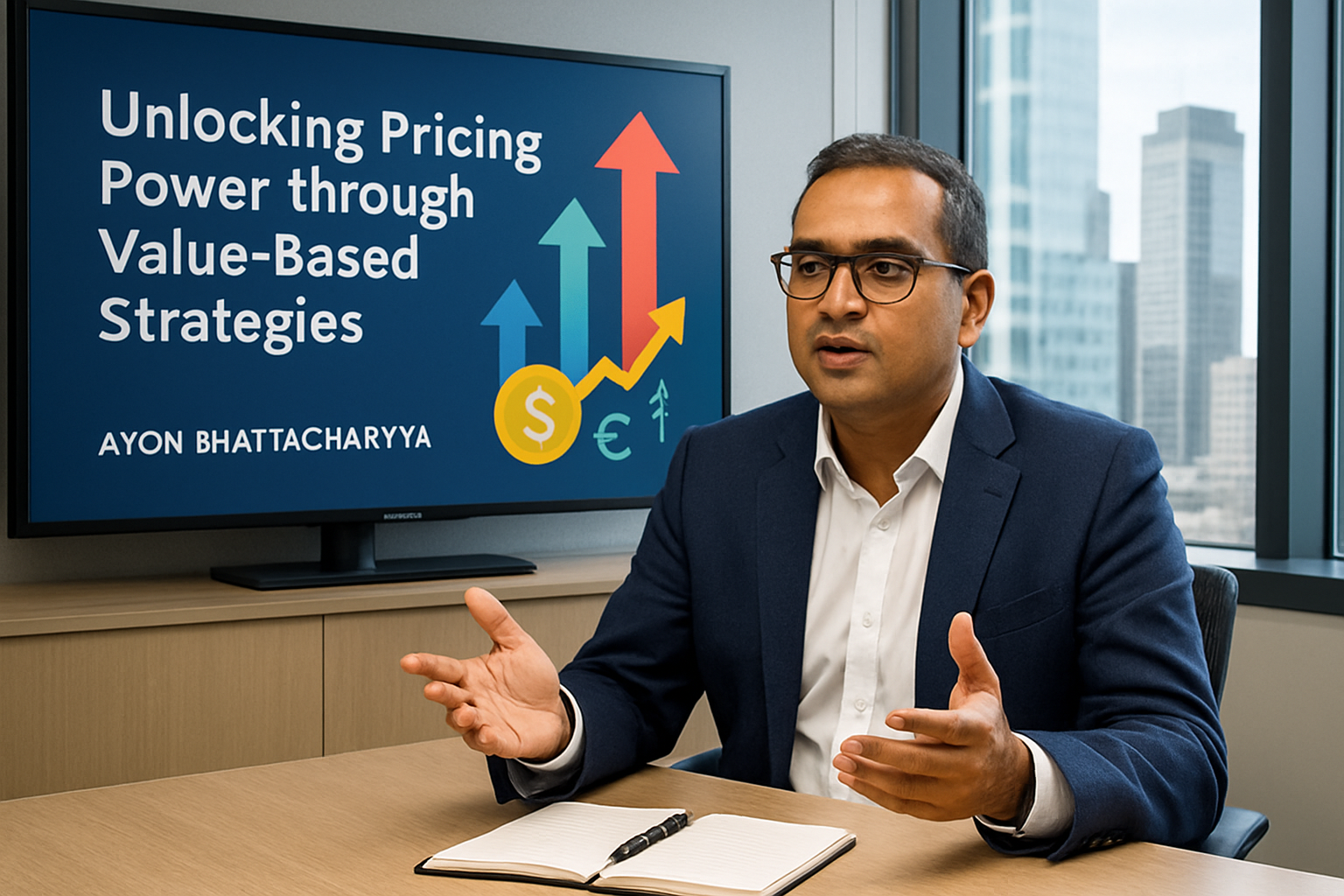
Our guest on this episode of Pricing Heroes is Ayon Bhattacharyya, the Founder & CEO of Biz Growth Spurt, a consultancy helping B2B SaaS and tech companies drive profitable growth through product marketing and price optimization by taking a value-based, data-driven approach. Ayon has more than 15 years of experience leading pricing and commercial strategy across various industries with dozens of global brands, including British Airways, News Corporation, Equifax and Telefonica O2.
In this episode, Ayon shares his experience working with brands to boost their pricing power and communicate value more effectively. He offers actionable strategies for navigating B2B pricing complexities, from understanding customer segments to utilizing data-driven methods for optimal pricing.
From Commercial Finance to Pricing Expertise
Ayon’s journey into pricing began in commercial finance and business partnering roles, where he obtained a CIMA qualification. His career took a pivotal turn in 2008 when he landed a revenue management role at British Airways, managing pricing for UK to North Atlantic routes. Ayon’s analytical skills, commercial acumen, and strategic capabilities drew him to pricing, leading him to various leadership roles across industries. He tells how his early roles in commercial finance laid a strong foundation for understanding the intricate details of revenue management and strategic pricing.
"Pricing ticked all the boxes for me," Ayon shares. "It aligns with analytical skills, commercial strategy, consumer psychology, and behavioral economics." This holistic view of pricing as a blend of various business disciplines made it an appealing career path for Ayon, who enjoys the challenge of integrating these elements to optimize business outcomes.
Industry-Specific and Industry-Agnostic Principles
Ayon highlights that while the principles of pricing are relatively similar across most industries, banking stands out due to its regulated, risk-based nature. Key principles like understanding customer value, identifying unique selling points, and measuring willingness to pay are industry-agnostic. However, B2B SaaS pricing is more nuanced, focusing on customer lifetime value and creating upgrade pathways. For example, in SaaS, pricing models need to account for long-term customer retention and the potential for upselling additional features or services over time.
"In B2B, you have more opportunity to understand how the customer benefits from your product," Ayon explains. "Value is generally more quantifiable in B2B, making ROI calculations crucial." He illustrates this point with examples from his work with B2B clients, where detailed ROI analyses helped justify premium pricing strategies and secure long-term customer loyalty.
The Art and Science of B2B Pricing
The B2B approach blends art and science. Ayon emphasizes the importance of value perception and the salesperson's role in building direct relationships with customers to influence this perception. This contrasts with B2C, where value perception is built through marketing and brand awareness. In B2B, the salesperson can tailor the pitch to address the specific pain points and needs of individual clients, making the value proposition more compelling.
"In B2B, the salesperson can personalize the value proposition based on the customer's unique needs," Ayon notes. "This direct influence is a key aspect of the art in B2B pricing." He shares stories of successful B2B engagements where personalized sales approaches significantly boosted client satisfaction and willingness to pay premium prices.
Customer Lifetime Value and Monetization
Ayon stresses the importance of demonstrating ROI to retain customers. He advises against relying on long-term contracts and instead focusing on proving value continuously. Offering options like flexible monthly plans and discounted annual plans can help balance customer needs and business cash flow. He cites a case where a client successfully transitioned from a rigid annual pricing model to a more flexible one, resulting in higher customer retention and satisfaction.
"You want customers to stay because they see value, not because they are locked in by contracts," Ayon says. "Proving ROI and offering choices can foster loyalty." He emphasizes the role of customer feedback and continuous improvement in ensuring that the perceived value remains high throughout the customer lifecycle.
Common Misconceptions and Effective Communication
Ayon addresses the misconception that businesses lose customers due to high prices. Instead, it's often a failure to communicate the product's value effectively. He emphasizes a structured approach to monetization, avoiding guesswork and competitor matching. He provides an example of a company that successfully increased prices by first enhancing and clearly communicating the additional value provided to customers.
"Customers care about the value you generate, not your costs," Ayon explains. "A structured approach to pricing can bridge the gap between perceived value and price." He highlights the importance of value-based pricing strategies that align closely with customer needs and expectations.
The BizGrowthSpurts Pricing Power Model
Ayon introduces the BizGrowthSpurts Pricing Power Model, which identifies four levels of pricing power: cost chaser, market pricer, value conqueror, and price optimizer. The most profitable companies become value conquerors and price optimizers, focusing on customer value and data-driven strategies. He explains how companies at the higher levels of pricing power use sophisticated analytics and customer insights to fine-tune their pricing strategies continuously.
"Pricing power enables you to charge what your product is worth," Ayon says. "It's about putting customer value at the center and continuously optimizing prices." He shares success stories from companies that transitioned from market pricing to value optimization, resulting in significant revenue and profit growth.
Practical Steps to Enhance Pricing Power
For businesses looking to enhance their pricing power, Ayon recommends understanding the value proposition, differentiating products, and conducting market research. These steps help identify customer needs, segment the market, and set prices based on value. He details a step-by-step approach that includes customer interviews, competitive analysis, and pricing experiments to validate assumptions.
"Start with understanding customer segments and value perception," Ayon advises. "Implement tiered pricing models and adopt a value-based approach to monetization." He emphasizes the importance of iterative testing and refinement to ensure pricing strategies remain aligned with market dynamics and customer expectations.
Recent Pricing Topics and Industry Challenges
Ayon discusses recent pricing news, such as the trending topics related to McDonald's and Red Lobster, highlighting the importance of aligning price increases with perceived value and the risks of all-you-can-eat deals, in the case of Red Lobster. He talks about the need for strategic use of discounts and clear communication of value. For instance, he suggested that McDonald's could have used the controversy around perceived price increases as an opportunity to highlight the superior quality and value of their products.
"Price perception is crucial," Ayon notes. "Align messaging with improvements in value and use promotions strategically." He explains how companies can avoid common pitfalls by ensuring that their pricing strategies are backed by robust data and customer insights.
Recommended Resources
Ayon recommends several resources for those interested in pricing:
- Books: Monetizing Innovation by Madhavan Ramanujan, Price to Scale by Ajit Guman, and The Strategy and Tactics of Pricing by Thomas Nagel and George Muller
- Podcasts: Street Pricing by Marcos Rivera and Impact Pricing by Mark Stiving
- YouTube: Ulrik Lehrskov-Schmidt's content and Ayon's own content
Transcript
Aaron: Hello and welcome to Pricing Heroes, a podcast sponsored by Competera. This is a series of interviews with the best-in-class retail pricing experts driving bottom-line metrics for major retail brands and the industry as a whole.
Today’s guest is Ayon Bhattacharyya. He is the founder and CEO of BizGrowthSpurts, a consultancy helping B2B SaaS and tech companies drive profitable growth through product marketing and price optimization by taking a value-based, data-driven approach.
Ayon has more than 15 years of experience leading pricing and commercial strategy across various industries with dozens of global brands, including British Airways, News Corporation, Equifax, and Telefónica O2. Ayon, welcome to the show.
Ayon: Thanks for that awesome introduction. I’m very much looking forward to our conversation.
Aaron: As am I. It’s not often that we have someone with so much experience across so many industries on the podcast. So can you begin by telling us a little bit about yourself and how you found your way into pricing?
Ayon: Yes, of course. Like most pricing professionals, at the start of my career I had no idea that I would end up in the pricing space. In fact, the first five years of my career were spent in commercial finance and business partnering roles, having obtained a CIMA qualification early on.
From there I sidestepped into commercial strategy roles and, in 2008, landed my first revenue management role at British Airways, responsible for pricing the ex‑UK to North Atlantic routes. Shortly after that, I moved to Australia and was involved in a number of strategy consulting projects for various organizations, but it was not until about eight years ago that I circled back to pricing and gained a true appreciation for just how versatile it is.
I was searching for an area of business that would align with my analytical skills, commercial acumen, and strategic capabilities, and that also involved an understanding of consumer psychology and behavioral economics. Pricing ticked all the boxes for me and I fell in love with it. I also loved the nuances and the different approaches between B2C and B2B, realizing that this field would feed my intellectual appetite long term.
From there, I made a point of taking pricing leadership roles across various industries to gain a wide perspective on the challenges that exist and to develop an understanding of best practices. Three years ago, I decided to start my own consultancy, BizGrowthSpurts, because I wanted pricing expertise to be accessible to small and mid-sized businesses, not just corporates that can afford to hire pricing teams or engage with the likes of Simon-Kucher or McKinsey.
Aaron: You’ve worked in various industries, including airlines, media, e‑commerce, banking, and now SaaS. How does the approach to pricing differ in each of these industries? And which principles have you found to be industry agnostic?
Ayon: That’s a really interesting question. I would say that with the exception of banking—which is completely different to most other industries, given the regulated, risk‑based nature of pricing—the principles are relatively similar across different industries. You need to understand how different customers value the solution, identify and communicate your point of difference, measure value and willingness to pay, determine the right pricing metric and model, and then test and iterate.
SaaS pricing, or monetizing subscription models in particular, is a bit more nuanced in the sense that acquisition is only the beginning. The majority of revenue is spread over the customer’s lifetime, which makes expansion critical to profitability and success. So when we work with B2B SaaS companies, we need to ensure that the packaging architecture creates a pathway to upgrades for various customers and segments.
Another key point is determining how you charge—for instance, usage‑based versus seat‑based, tiered versus modular pricing—which is essentially your set menu versus à la carte or your all‑you‑can‑eat buffet. This is very much dependent on the way in which value is generated for the end customer.
I would say the bigger distinction lies in the approach to B2B versus B2C. In B2B, you have much more opportunity to understand how the customer benefits from your product or service. Capable salespeople can then leverage this to improve value perception and therefore charge higher prices once the customer has been convinced that this is the only solution that meets their unique set of needs.
When it comes to understanding willingness to pay, there are fewer data points in B2B. Typically, experimentation and research methodologies are a better approach than calculating price elasticity, for which you require a large data set. Value is generally much more quantifiable in the B2B space, and calculating ROI across different feature sets will help customers decide which option meets their needs, as well as differentiate the proposition from competitor offerings. Product versioning is also key to attracting customers with a range of budgets and needs.
While much of this holds true for B2C as well, it’s not unusual to have teams of data scientists in B2C perform price sensitivity analysis across much larger data sets and build multivariate elasticity models. I would also argue that the B2B approach requires a larger degree of art along with the science.
Aaron: I’d be interested to hear exactly what you mean by art versus science in this context. From a B2B perspective, one of the key features in the sales cycle is the development of relationships. You can be more personal in the B2B sales cycle than you can in B2C. I’m thinking as someone who’s been working in marketing: how do we appeal directly to our ICPs? That is entirely different in B2B than B2C. In B2C, in order to truly personalize, you have to get granular, but the customer is still just a number. Whereas in B2B it’s an entirely different game. Maybe you can elaborate on what exactly you have in mind when you’re talking about the art versus science of B2B pricing.
Ayon: I think you nailed it there. It’s about value perception. In the B2B space, the salesperson has the opportunity to build a direct relationship with the customer and actually influence that value perception, whereas a lot of the value perception in B2C is built up through marketing and brand awareness. It’s difficult to do that on a very personalized level in B2C, to influence based on a personal set of circumstances, use cases, or unique needs. In B2B, that personalization is very much part of the approach we take with clients. Does that help?
Aaron: It does, and I completely agree. As someone who’s been on the buyer side of a lot of SaaS products for corporations, one thing that appeals to me is when I’m interacting with a team that understands my objectives, the challenges, and what I need to do to become the hero within my organization. Sometimes companies approach us with a specific package—or say there are three packages—but there isn’t much flexibility, and each package fails to deliver the value I’m looking for as a buyer.
It doesn’t make sense if the base package is 8,000 per seat and the next step up is 20,000 or more, and there are only some features in that next tier that would be appealing to me. When there’s no flexibility in negotiation, I don’t see a lot of value in it. It seems like they’re pricing for something other than the value for me as the buyer.
Ayon: I’m sure we could spend hours debating the pros and cons of simplicity versus flexibility. In SaaS, you’ve got PLG, which is product‑led growth—typically for small to mid‑sized businesses depending on the complexity of your solution—versus SLG, which is the sales‑led growth model. The pricing approach varies quite considerably between the two.
It’s important to find the right balance between simplicity and the complexity that enables you to segment and capture value in the most effective way through your pricing model. From a customer perspective, you also don’t want to confuse them. So it’s a tricky one.
Aaron: Of course. You mentioned customer lifetime value, and I’m wondering how you calculate this in SaaS. From a buyer perspective, I know it happens because there have been plenty of times when I purchase a product and the initial agreement is reduced by 30 or 40 percent from the price initially quoted to me, and I take that deal. Once my organization is locked into the product, it’s very difficult to extract ourselves. How are pricing experts thinking about this in terms of customer lifetime value?
Ayon: It’s never a good situation to be in when you’re relying on contracts—long‑term contracts—to keep the customer. Ideally, you want to be demonstrating enough value and proving out that value to keep your customer because they want to be there. They are generating more revenue as a result of using your product or service, or they’re saving costs.
Ideally in the B2B space, you want to quantify that value and be able to demonstrate ROI, particularly in the current inflationary environment where CFOs are more discerning and procurement teams are shopping the wider market to get the best bang for their buck.
To avoid a buyer turning into a price buyer, you ideally want them to be a value buyer. That is dependent on how you approach the conversation from a sales perspective. Don’t start with price. Ask the right strategic questions to understand exactly how they’ll use the product, understand the problems and the use case, and get the customer to buy into the ROI model. That’s key. If they don’t believe it, then there’s no point—you can put ROI numbers in front of them, but if they don’t believe it, it’s a waste of time.
Aaron: That makes a lot of sense. Just to clarify, the reason I said we were locked in is because we saw the value of those tools. They persuaded us to commit with a reduced price initially. We got in, used the tool, and found it incredibly valuable for our organization. When we went back to negotiate, they had more leverage because they could see how much we were using the product and say, you’re getting value out of it in these ways. That plays into your emphasis on understanding and focusing on value.
Ayon: One more thing I’d add, which I advise companies I work with, is to provide options. You might have a monthly option, which is fully flexible, and then an annual option, which is a bit more of a tie‑in. The customer pays a year upfront but receives a discount for that. In SaaS, that’s extremely beneficial to the business in terms of having cash flow up front, which they can reinvest into product development, sales, and marketing.
It’s about choice. You’re not forcing the customer to do that, but if they want the discount, they’ll choose it. Often you might have a trial to demonstrate the value up front before asking them to commit.
Aaron: That’s a phenomenal point, because as a buyer I love being able to pay for a couple of months to really work with the tools and see if it makes sense before I commit to a long‑term agreement. I wish more businesses would take that approach if it makes sense for them.
Ayon: Absolutely.
Aaron: What we were just discussing ties directly into a LinkedIn article that you authored, in which you claim that one of the biggest misconceptions around pricing is that businesses often assume they lose customers because their products are too expensive. You go on to explain that it’s actually more likely they lose customers because those customers don’t understand the unique value of the product. How have you seen businesses effectively monetize and communicate the value they deliver to customers?
Ayon: It all starts with understanding the market dynamics and customer needs, and figuring out where to position yourself in the ecosystem. What unique problems are you solving better than others? What’s your point of difference? How should customers perceive your solution?
Once companies have clarity on that, the next step is to look at product attributes and figure out how perceived value varies across different segments based on varying needs and use cases.
Apple does this particularly well by charging a premium price on new phone models to early adopters. As another model enters the market, the price of previous models gradually drops to make those phones accessible to other user segments. Their strategy is to market the uniqueness and novelty of their technology in order to support higher prices.
I would expect that they have teams that test desirability and willingness to pay for various features prior to launching new products, just as Porsche did prior to launching their Cayenne SUV. I cannot overemphasize the importance of the test‑and‑learn approach for all aspects of product marketing and pricing.
Aaron: Understanding the differentiators you as a brand offer and monetizing accordingly is key. The challenge seems to be that there’s often a disconnect between the pricing of the product and the communication or perception on the customer side. There’s an example I wanted to bring up later about McDonald’s and the pricing of Big Macs and the perception of their value.
There are plenty of examples where customers talk about price perception versus value. We can assume that when people complain about pricing there is a disconnect. Would you say that’s the case, or do you think it’s just human nature to complain whenever they see the price go up—which doesn’t necessarily mean there’s a disconnect between monetization of value and communication of that value or the customer’s perception?
Ayon: It could be that the business hasn’t communicated the value well enough, so customers don’t really understand the solution. When that happens, they fall back to price because it’s the easiest lever to focus on. In cases where there is a disconnect, it’s usually because the business hasn’t taken a structured and scientific approach to monetization. Founders or leaders often resort to guessing, matching competitors, or worse, cost‑plus pricing—adding an arbitrary margin. In that case there will always be a disconnect to value perception.
Aaron: Let’s dive into that. In the same article you present the BizGrowthSpurts Pricing Power Model. Can you explain this model and how you apply it?
Ayon: Sure. One of the major contributors to successful monetization is the level of pricing power within an organization. Pricing power is defined as a company’s ability to raise prices without losing customers or seeing a drop in demand—or, put another way, the ability to charge the price it deserves for the value it delivers.
Pricing power enables you to generate more revenue, which in turn drives greater profitability and cash flow, and it is one of the most important considerations when it comes to funding and valuations. In every market we identify four levels of pricing power: the cost chaser, the market pricer, the value conqueror, and the price optimizer.
As a cost chaser, you’re working out your costs and adding a margin. As a market pricer, you look at your competitors’ prices and set yours similarly—maybe you’re just going with your gut. Both of these approaches can be profitable, but both leave money on the table because neither considers differential value or willingness to pay. The most profitable companies strive to become value conquerors and price optimizers—putting customer value front and center, being driven by data, and matching their customers’ purchasing and usage habits.
Operating at level three or four—value conqueror or price optimizer—does not mean you’re ignoring costs and competitive pricing, but rather that these are benchmarks for prices you set based on segment value and willingness to pay.
I’d like to think there are very few companies that operate at a cost‑chaser level, but in reality there are many industries that still use cost‑plus pricing. That is ineffective because your customers do not care about your costs; they’re internal to you. They only care about the value you generate for their business. We see a lot of SaaS companies stuck at the market‑pricer level and struggling to move to value‑conqueror and beyond without seeking pricing expertise to achieve the coveted status of price optimizer, which only about five percent of companies reach.
Price optimizers will have incorporated everything from the previous levels, implemented continuous price optimization processes, set prices that vary by segment, deployed pricing engines that drive automation, and adopted a differentiated value‑selling approach. They’ll also have governance frameworks in place and controls around discount management. That’s the framework. It’s hard to explain in words; I’d love to show it as a diagram, but perhaps you can link to it.
Aaron: I’ll definitely link that in the show notes. From a practical perspective, what are the first two or three steps businesses should focus on to move along this pricing‑power maturity curve? If a company is a cost chaser or market pricer and wants to become a value conqueror or price optimizer, where should they start—besides hiring you to consult on their pricing strategy?
Ayon: First, ensure you have a clear understanding of the value proposition. Develop deep knowledge of customer pain points, identify use cases, understand your point of difference, and define your acquisition model.
Second, look at product differentiation—how feature value varies across different groups of customers. Assess the packaging architecture and build a ladder of value. Determine which features belong in which feature sets and which should be add‑ons. Also look at the service model, because value is not just about the product; it’s the whole end‑to‑end solution—from onboarding and product usage through to service and customer success. The sales relationship is part of that. It’s all encompassing.
Third, conduct market research and gather insights. Analyze usage data and how it varies across different groups of customers. Define your target market and ideal customer profile. Perform pricing research such as conjoint analysis or Van Westendorp to understand willingness to pay and to identify pricing ranges. Also assess the relative importance of features to different customers. Look at buyer personas and your overall segmentation model. There are two further stages after that, but I’ll leave it there for now.
Aaron: That’s great. If any of our listeners want to learn more, they can reach out to you and schedule a call.
Ayon: Sure.
Aaron: I want to return to the industries you’ve worked in. You mentioned that banking is uniquely challenging. Which other industries have proven to be the most challenging in terms of pricing? Maybe you can provide specific instances and the solutions you provided.
Ayon: My biggest challenges in pricing have been structural and cultural rather than industry‑specific. There is often a lack of understanding around how pricing teams should engage and integrate into the wider organization. There should be a healthy tension between pricing leaders, sales teams, product, and finance, and the pricing function needs autonomy to make decisions—or at least to objectively influence leadership—based on the overall company strategy and holistic goals of the business rather than those of a single function.
Ultimately, pricing touches every level and every business function. For this reason, pricing leaders are best set up for success when they report directly to a CEO or strategy executive, independent of sales, marketing, product, or finance. Regardless of reporting line, pricing functions still need to be embedded in commercial teams to get the required exposure to business‑unit strategies, market dynamics, customer value propositions, and margin analysis.
A specific challenge across multiple businesses is pricing governance and controls. Sales teams—or buyers in retail—often feel they should have full ownership of pricing. When a pricing leader or a consultant such as myself comes in to put more structure around the process, it rarely goes down well. In my experience, the best way to overcome this is to demonstrate how more optimal pricing will help sales teams hit their revenue targets and to convince the C‑suite that lack of discount management is leading to margin dilution and revenue leakage. When the data and insights support the business case to shift the modus operandi, leadership gets behind it, and over time other functions come on board.
Aaron: There seems to be a general consensus across pricing experts and consultants that organizational structure and full integration are paramount to any successful pricing strategy.
Ayon: Totally.
Aaron: You’ve mentioned several principles on the call today, but if you had to distill them into two or three top pricing principles that should be top of mind for every business when monetizing their products, what would they be?
Ayon: Number one: understand customer segments and value perception. Different customers derive varying levels of value from your solution. Identify and segment customers based on specific needs, usage patterns, and willingness to pay.
Number two: implement tiered pricing models. Create different pricing tiers that cater to various customer segments. Each tier should offer a distinct set of features and service levels.
Number three: take a value‑based approach to monetization. Set prices based on perceived value to the customer rather than just the cost of providing the service. Conduct market research, customer surveys, and competitor analysis to understand how much customers are willing to pay for specific features and benefits.
Aaron: That’s very relevant for marketers as well.
Ayon: There’s a lot of overlap—part marketer, part product person.
Aaron: Absolutely. Now I’d like to turn to a few recent pricing topics that have been in the news. Customers at McDonald’s took to social media to voice their frustration about increases in Big Mac prices, claiming that the price had doubled since 2019. McDonald’s U.S. President Joe Erlinger came out publicly to correct the record, explaining that the average U.S. Big Mac price increased only by 20.5 percent. While he’s right, it seems to me this was a missed opportunity for the company to address customer sentiment—the perception, not the facts—that can have a significant impact on buyer behavior. I’d love to hear your thoughts on this situation and perhaps you can share tactics businesses can use to ensure they align price increases with perceived value over time.
Ayon: The reality is that McDonald’s tends to attract mainly price buyers. By definition, these customers are highly sensitive to changes in price. It is common for businesses across multiple industries to blame price increases on rising costs, particularly in the current inflationary environment. While some customers might be sympathetic, it’s important to remember that customers don’t really care about your costs; they are internal to you.
Rather than responding in a defensive manner and educating customers on their misconceptions, I think Joe Erlinger missed an opportunity to relate to customers why McDonald’s is superior to competitors and to remind them of the compelling reasons for choosing to eat at McDonald’s. Given where McDonald’s positions itself in the market, price perception is extremely important. Having five‑dollar deals to increase footfall gives them the opportunity to upsell more premium products. This is similar to the way SaaS companies might offer freemium as a means to quickly grow their customer base with a view to monetizing them later on. Customers have experienced the product.
One thing I would add is that without the right expansion‑revenue strategy—and if they attract the wrong customers—freemium can quickly burn through resources and cash flow. It’s quite a high‑risk approach if those customers come on board, don’t upgrade, and demand high levels of support.
Generally speaking, when companies implement price increases, they should do the following: do it as early as possible to give customers time to adjust their expectations and budget; align the messaging to improvements in value so customers don’t feel like they’re being ripped off; make gradual increases and potentially grandfather existing customers over a period of time, such as six months, to show goodwill and minimize churn impact; segment customers based on willingness to pay and be surgical and strategic about the increases as opposed to applying them uniformly, which would underprice some customers and overprice others. Also consider a phased approach, which applies more to B2B: test increases with a subset of customers and measure the response before applying them to the rest of the base.
Aaron: That makes a lot of sense and seems to tie together much of what you’ve discussed so far. There’s another food‑related topic I’d like to raise: Red Lobster, one of the largest seafood chains globally, recently filed for bankruptcy and is in the process of closing 50‑plus locations. They stated that labor and lease costs were major contributors to the restaurant’s declining performance, but perhaps one of the most influential factors that recently made news was its pricing and promotion strategy—specifically, the decision to make its limited‑time Endless Shrimp offer a permanent item on the menu, which reportedly caused 11 million in operating losses. If you were consulting for Red Lobster on its pricing strategy, what advice would you have given the executive team around this Endless Shrimp promotional strategy?
Ayon: All‑you‑can‑eat deals are always risky for several reasons. You have no control over consumption, and costs can quickly spiral. We saw the same with MoviePass when they launched their unlimited movie offering in 2017; they went bankrupt within two years.
If you decide to offer an all‑you‑can‑eat deal as a way of differentiating, you need to be very clear on the breakeven and ensure your margin covers even the worst‑case scenarios. I would recommend applying a fair‑usage clause to prevent abuse. It’s also important to consider how the offer will impact brand perception. Imagine the headline: Red Lobster Contributes to Rising Obesity Levels in the U.S. That’s not a great look. You need to ask whether this aligns with your target market and brand positioning.
All‑you‑can‑eat deals often significantly limit—or actually kill—the upsell, which leaves you with no further options to monetize the customer. I’ve worked with several SaaS clients who fell into this trap when they offered all features to all customers at a fixed price. It is far more profitable to differentiate prices across versions of your product based on needs.
Limited‑time offers are a great marketing tool to create buzz and pull customers through the door during periods of low demand, but the moment these become permanent, customers get conditioned to paying less for more value, which impacts willingness to pay across your entire product set. My advice would be to use discounts and all‑you‑can‑eat offers cautiously and strategically, when you truly need to.
Aaron: That makes a lot of sense. You mentioned MoviePass. As an early adopter of MoviePass, I was very sad when the business model fell through because I loved that subscription and the ability to go to the movies whenever I wanted, which was very often. I didn’t understand the business model, but it benefited me for those first years.
Ayon: If you can make it stack up, it’s a brilliant proposition and a great way—especially after COVID—to bring people back to the movies and to compete with the likes of Netflix, Neon, Prime Video, and Disney. But I would have recommended different packages: you pay a certain subscription and get a cap on the movies—10, 20, 30, whatever it is—and then the unlimited tier is twice or three times the price of where they actually positioned it. That way you’re making sure you’re not unprofitable on the offer.
Aaron: That’s precisely what many MoviePass users were saying. They were willing to pay two or three times the price because of how frequently they went to the movies. If I’m not mistaken, I think MoviePass tried to move to that model later on with tiers and limits, but it was too little, too late.
Ayon: This comes back to really understanding your customers’ usage patterns and segmenting accordingly in a scientific way.
Aaron: Final question: can you recommend any books, podcasts, or other resources to our pricing community?
Ayon: Sure thing, Aaron. Monetizing Innovation by Madhavan Ramanujam and Price to Scale by Ajit Ghuman are excellent entry‑level reads on pricing principles and approaches. The Strategy and Tactics of Pricing by Thomas Nagle and Georg Müller has been like a bible to me throughout my pricing career. In terms of podcasts, I really like Marcos Rivera’s Street Pricing podcast—he’s got heaps of charisma, he’s down to earth, and he always keeps it real. I’d also mention Mark Stiving’s Impact Pricing podcast, particularly as I’ve been fortunate enough to get the hat trick with three appearances to date. And Ulrik Lehrskov-Schmidt has some great content on his YouTube channel, which I would recommend your listeners check out. Lastly, feel free to check out my own YouTube channel and website for blog posts, case studies, and pricing‑related content.
Aaron: Awesome. I’ll be sure to link those resources. I love the Street Pricing podcast with Marcos Rivera. It’s phenomenal.
Ayon: He has a way of making pricing sound so interesting and exciting—which it is—in the way he conveys it.
Aaron: For sure. Great. Thank you so much for being on the show and sharing your insights with us today.
Ayon: Thank you so much for having me. I’ve really enjoyed this.
Aaron: I hope you enjoyed our conversation with Ayon. Be sure to follow and connect with our guest on LinkedIn. For more information about AI pricing solutions, visit competera.ai. Remember to subscribe to the show on your favorite podcast app to ensure you don’t miss future episodes. And please help us spread the word by leaving a five‑star review; it helps others discover the show. If you find the insights valuable, check out the Retail Pricing Community on LinkedIn, where you’ll find pricing experts sharing their expertise and the latest trends. Thanks for joining us on this episode of Pricing Heroes. Take care—until next time.

.png)